I Couldn't Help It—I Had To Square the Circle!
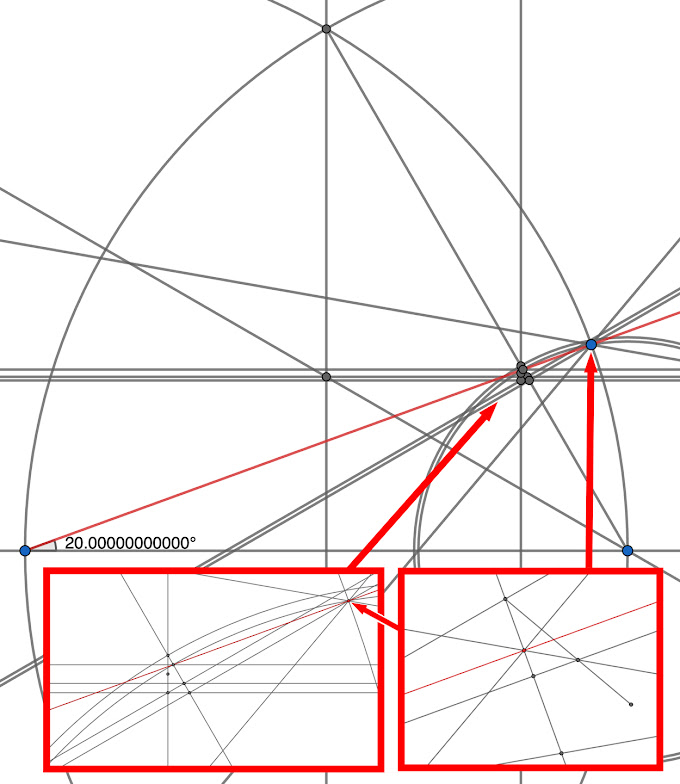
After enjoying the summer, I got to thinking about a 20° angle I ran into last year, which had an arc length of π. I wondered, "Would it really be so impossible to straighten out an arc and geometrically produce a line segment the length of pi?" If 2πr equals the length of a circle’s circumference, then a semicircle with a radius of 1 would have a 180° arc equal to π. My 20° angle goes into 180° nine times, so by having a radius of nine, its arc also equals π, right?

And the longer the radius, the shorter the angle’s arc and the less curvature it has. So in GeoGebra I explored how close to linear π the arc of an angle could get by going long on the radius and short on the arc. To do this properly, I could only use conventionally constructible angles for a geometric solution.
Last Tuesday, September 1st, I managed to geometrically construct a line segment the length of π to 15 decimal places, GeoGebra's maximum. Because π is considered a transcendental number under the Lindemann-Weierstrass theorem of 1882, to do this geometrically is considered mathematically impossible. What I did wasn’t an infinite π, but if an infinitely large circle were available using an infinitely powerful computer and similar actions operated at that level, would it be so impossible? But this is the real world and computers have constraints so this is a practical solution, not a mathematical proof.
I started with an angle of 0.00001072883606° (rounded by GeoGebra from 180°÷2^24=0.000010728836059°), the same result as bisecting bisections of 180° 24 times, and having a radius of 16,777,216, or 2 to the 24th power. (In inches, that would be close to 264.8 miles!) This produced an arc length of π, which is such a small segment of such a large circle it appears to be very nearly a line. The angle was bisected and its arc midpoint was reflected off the point at the arc’ base. On a line segment, the distance between arc midpoint C and the reflected point C’ measured 3.141592653589793, an accepted value of π to 15 decimal places.

Having geometrically established a value for π, it was then fair game to construct its square root, so a new construction ensued. A geometric square root using the numerical π to 15 decimal places was constructed, from which a square with sides of that length has a measured area of π. And a circle centered at the square’s center with a radius of 1 also has the area of π, thus geometrically completing the classic "Squaring the Circle" within the computer’s limits.

After summer, I was refreshed and Squaring the Circle came together like cool jazz. To help keep the mind fertile, it’s good to have varied interests and take a break once in a while. I thank those around me for this, but I also have to give credit to all those who made personal computing and GeoGebra possible, because the crucial angle has such a long radius this solution, limited to 15 decimal places though it is, would have been impossible without the tools they made. Anyway, where else could I ever find a compass able to span 265 miles, let alone a long enough straightedge, piece of paper, drawing board, and place to set it up?! Only Archimedes knows.


Comments
Post a Comment